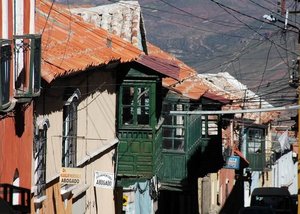
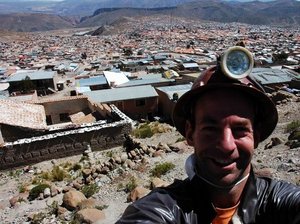
Potosí - once a synonym for wealth. Today still an important mining town. The main hill - Cerro Rico - contains an enormous variety of minerals. Potosí is the highest city in the world with more than 100.000 inhabitants and an altitude of 4000m.
Walking around in the city is a great pleasure, many older and a few colonial building remain. And I found many interesting little corners in town which indeed required a little time to discover. Again I enjoyed the fact I could speak to the people, e.g. the conversation with the friendly old lady I met in a tiny little market square (see the picture below). Most travelers only come to Potosí to take a tour to the silver mines in Cerro Rico, but I think the city has a lot more to offer!
I did the tour as well - yesterday. The tour to the mines is an experience. It's really intense. The working conditions are rough, to say the least. "Medieval" would apply, too. We first got a complete set of clothing; jacket, over-trousers, gum boots, helmet with lamp and battery. It was recommended we did not take anything besides our camera - the mines would partly be very narrow (and they were!). Then we went to the miners market where our guide demonstrated the proper use of coca leaves and catalysts, the different varieties of dynamite available (Bolivian - cheap and good quality = bang for the buck, the paste can be formed to need; Peruvian - cheaper but bad quality; Argentinian - more expensive, very good quality, unfortunately not anymore available on the Bolivian market), nitrate to enhance the explosion, how to put the fuse into a roll of dynamite. We were then introduced to the miners favorite drink - pure alcohol of 96 degrees. Not too bad, actually. We bought some of these items as presents for the miners later on. A complete set of dynamite including a bag of nitrate and a fuse is available for as little as 2€ - freely available for everyone, even for kids. Also frequently used as firecrackers in the streets. A little unsettling.
Then we visited a plant where the mineral is being grated and the metal extracted. It looked more like a chemical plant of the 19th century. No security for the workers whatsoever. But still a lot better working conditions than the actual mines!
Then the mines, which we visited during normal operation. Our guides assured us they would know where currently dynamite was being used and where the carbon monoxide levels were too high. I am lacking the words to properly describe what I have seen. Pictures of the tour continued flashing back in my mind and kept me awake all night. Very strong experience! We first had to wait until the mineros who push the carts had passed. No one would stop in the mines for a few tourists... The entrance tunnel already appeared to me very narrow, already here almost no spot to stand upright (for me at least). We were told not to touch any of the cables and tubes that were dangling everywhere. No order to be recognized.
After a stop in a little cave used as "museum" with a few items and explanations on the mines we went further on into the first level. Now things became really narrow and low. Occasionally crawling on hands and legs we had to fight our way through the incredible fine dust. We were now at least 200m inside the mountain and the temperature had risen to about 30 degrees. Breathing was very hard, not only due to the 4300m meters of altitude! Our guide made us climb upwards through a hole in the rock which appeared incredibly small. Well, I guess being tall is quite a bad thing under such conditions. There were some odd wooden structures to secure rocks and prevent rubble and sand from falling further down. We arrived at a tiny little cave with a wooden construction and an electric winch with which one of the workers would pull out huge leather bags with minerals from a 50m deep hole. There was barely enough room for the eight people in our group plus our guide huddled up on the rock walls and the worker. The ground we had just crossed turned out to be a hole in the floor through which the minerals were passed into some carts further below. Absolutely no security standard whatsoever. We left a bottle of fizzy drink and coca leaves with the poor soul and kept climbing and sliding through more narrow holes in the rock until we reached a part where a strong basic solution was left to seep through the soil as a method of filtration. Nowhere space even to properly sit upright. Then sliding and crawling down again through a very dusty tube into the main tunnel where we visited three guys working on other prehistoric machinery. More gifts were handed over here, and the workers started chewing their coca leaves. They work for at least 10 hours under ground - without food. The coca prevents them from noticing hunger and thirst... Some would stay 16 and even up to 36 hours in the mine without sleep if they would not encounter minerals. They all work basically freelance, most in cooperatives of a couple up to about fifty people.
Although here the air was still "relatively" good but dusty, I decided I had seen enough after about three quarters of an hour. I felt I would be better off leaving as long as I felt still well, and so I asked one of the guides to walk me out. The relatively straightforward walk/crawl back to daylight took about an other 15 minutes. And I did enjoy every minute in fresh air of the about two more hours I had to wait for the rest of the group returning. Apparently I had left at a good spot, just before they would go down to levels 2, 3, and 4 where, according to the others, things turned even more nasty. Creeping down and up through very low passages with heaps of dust, having to climb down shaky wooden ladders with many damaged and missing steps, really bad air and so on. When the others finally stumbled out of the tunnel, everyone was very glad to be back out again and truly exhausted. And everybody was thickly covered in dust and dirt.
No surprise about 40 people die annually in these mines. The estimate is that about 8 million (no typo!) people have died in total in the mines during the last 500 years. The Spaniards often would not even let the indian slaves out of the mine at all.
As a sort of final entertainment we were made to blow up a few sticks of dynamite. I was shown how to push the fuse into the dynamite paste and before I knew any better I had a stick of dynamite in my hand with a burning fuse! No joke! Some of the others had the same experience simultaneously... So there we were, looking bewildered at the dynamite in our hands. I tried to keep calm and attempted to extract an explanation out of our guides on what to do next. In place of an answer the guides would just snatch the dynamite sticks out of our hands and run a little into the hill where they let them detonate just somewhere. Totally crazy!
Hard to believe people actually work under these conditions. Hazards and chaos everywhere.
More photos here.